Official Website | FreeBASIC Programming Language. Just stumbled upon it (don't ask), a free Basic compiler that is oriented towards QuickBasic.
basic
The ElfData Plugin. For future use, more efficient string classes and structures than the standard ones in RealBasic. And basic structures for parsers and tokenizers. Eventually, I want to build my own Markdown processor for my Desktopwiki instead of constantly calling external tools.
X11-Basic Homepage. And since I'm on the topic of Basic - X11 Basic is a GFA Basic clone that has many extensions and runs on all possible systems. Among other things, there is also an Android version - although on my Galaxy Nexus the font is no longer elderly-compatible and on the Nexus 7 I'm considering reaching for a magnifying glass. With this Basic, however, it's more about being able to maintain old habits rather than really working with the new systems - the Android specifics are quite manageable.
RFO BASIC! for Android. Fun system to play interactively with Android stuff - and especially to do that on the go. Basically a souped-up Basic with support for various Android sensors and access to all kinds of system services (e.g. SQLite), so you can really do a lot with it. Basic programs can even be converted into APKs that can be distributed as standalone apps. This brings back the feeling of programmable calculators from the 80s - amateur programs, but self-made hacks and tools.
Basic4android Basic for Android - Rapid Application Development. Heh, nice, a kind of Visual Basic for Android. Unfortunately only for Windows. Too bad.
Remote Debugging - Real Software Documentation. Other systems should take a few slices from this. In my game project, I had a problem with the latest version under Linux. However, my development environment is OSX, where everything runs smoothly. So what to do? Well, a good opportunity to take a look at the remote debugger. And it's really trivial. Boot up a Linux system (I use Vagrant on my OSX machine), copy over the remote debugger stub, run it, configure it minimally, and get started. Directly from the OSX IDE, transfer the compiled code to the remote environment and start it, directly with breakpoints and variable watch and such things. Basically, all that I would also have locally with OSX. In principle, there is almost no difference, except that the program runs on Linux. Why is it so much more complicated in so many other environments? I guess I'm getting old, I just don't have the patience for cumbersome environments anymore.
..Nowhere.. has a series of free classes and plugins for RealBasic, including one for a syntax highlighting editor and list boxes with arbitrary cell content.
Thomas Tempelmann | Arbed - The Advanced RB Editor. You stumble upon all sorts of things - I still know Thomas from Modula-2 times, he was like the Modula-2 compiler guru back then. And now he uses Real Basic. And he has built a quite interesting tool for working with RBP files, which I should take a look at because it could simplify a few things (especially versioning, the possibilities that RB offers out of the box are not very impressive). And yes, I really do use Basic. No joke.
REALbasic | Open Source | Charcoal Design. Open Source for Real Basic. Yeah, I'm currently programming things for myself in Basic. And honestly: it's fun. I found this site while searching for JSON implementations for Real Basic.
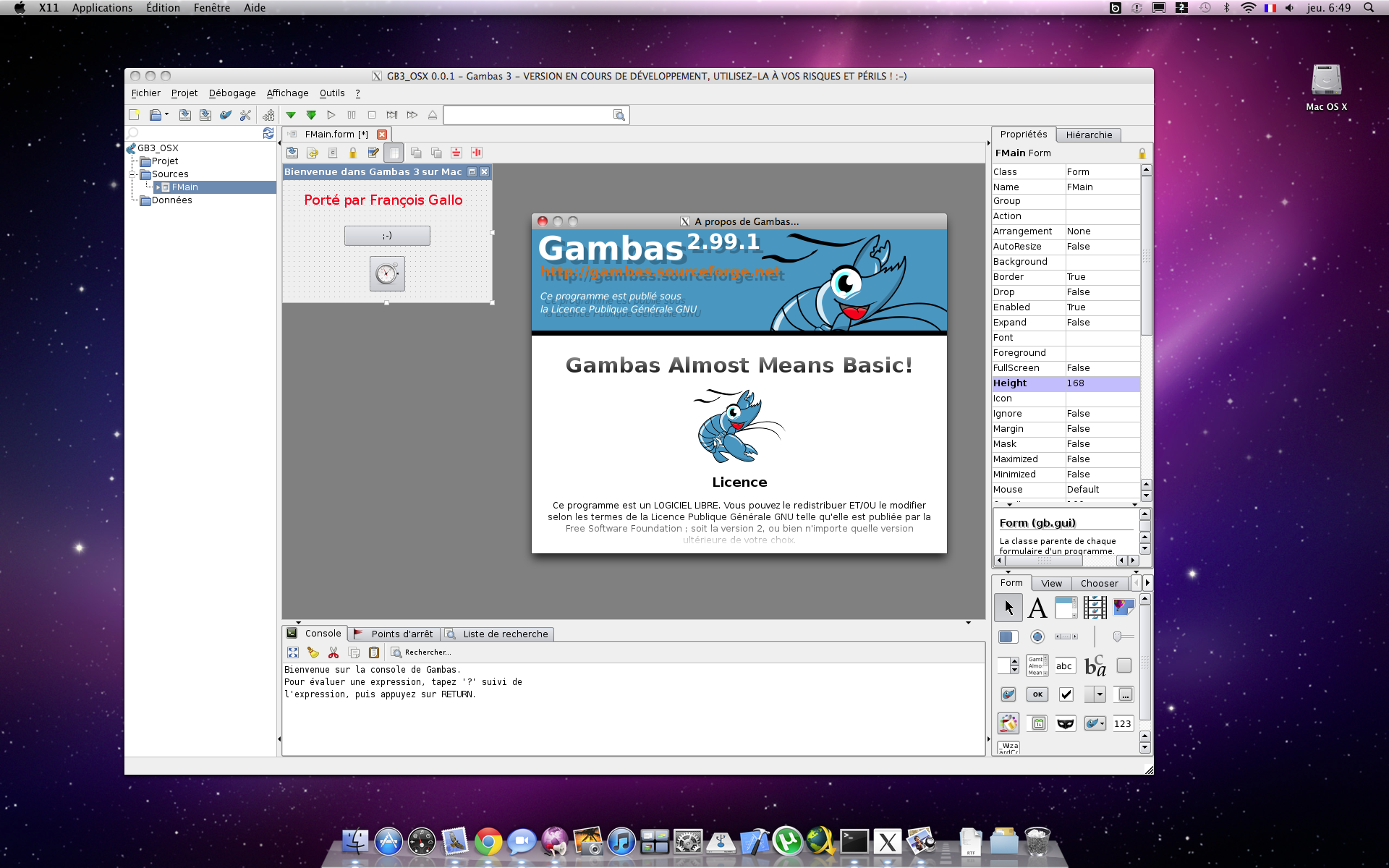
Gambas - Gambas Almost Means Basic. Ok, and now it gets really wild, but I thought after RealBasic I can't help but also link to Gambas, a kind of VisualBasic clone for various systems. Can work with different databases and different GUI libraries. And a port to OSX is now available (June 2011, so still quite fresh), which also sounds promising for the future, as Linux and Windows are already supported. And yes, I know, "real" programmers turn up their noses at things like VisualBasic, but it is very useful for quickly putting together graphical tools and is particularly interesting for occasional programmers.
I didn't know HyperNext Studio at all. A HyperCard clone for Mac, with which you can also create Windows applications. However, the last version is a bit older, I don't know if it still runs with Lion. Meanwhile, it is freeware (though closed source, I guess because their last version is already a bit older). And also interesting: it offers two languages, one that is modeled after HyperTalk and RBScript, an object-oriented Basic from Realbasic (another IDE for OSX and Windows). I guess HyperNext itself might be programmed with Realbasic. Oh, and with the HyperNext Android Creator you can also build Android applications with HyperNext. The Android Creator is however paid (but not really expensive with 60 dollars). And unfortunately, it is only available for Windows, not for the Mac. Update: those who have Lion can forget about playing with HyperNext Studio, because it is PowerPC code, and there is no Rosetta in Lion. So the maximum OSX version is Snow Leopard.
Microsoft Small Basic. In a strange way, nostalgic. A Basic in the style of QBasic, but for Silverlight and the browser with libraries for graphics output and similar things. Essentially something like Processing, but .NET instead of JVM and Basic instead of Java.
qb.js: An implementation of QBASIC in Javascript (part 1) - Steve Hanov's Programming Blog. Blasts from the past.